Local-first visual explanation · Architecture · September 2026
BOB: The Bureau of Blueprints
Give BOB an architecture document. It identifies the connected actors and their interactions locally, then produces a narrated, shareable Blueprint that can be opened in any modern browser.
Version 0.1. BOB is a working portfolio product and an ongoing experiment in concise technical explanation. Despite its name, it is not an operating bureau, public authority or standards body.
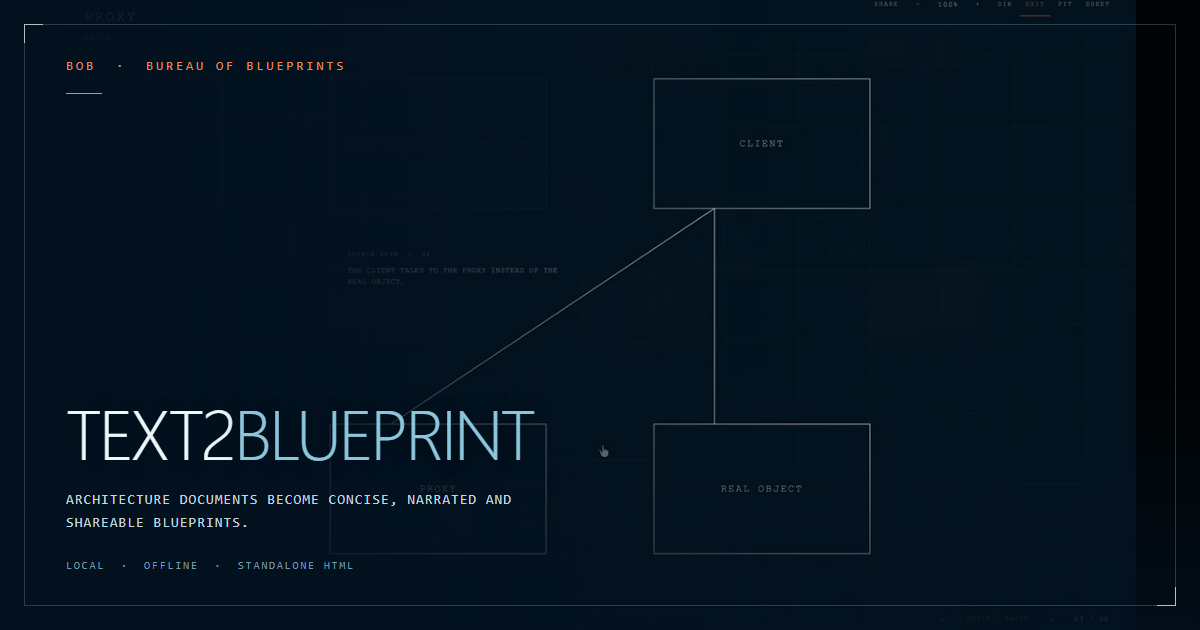
The complete path
Provide a plain-text architecture document and choose an output folder. BOB finds the participants that actually interact, selects the meaningful relationships supported by the document, arranges them into a Blueprint, and packages the drawing, sequence, notes and optional narration into one self-contained HTML file.
Video demonstration
See a complete architecture document become a narrated standalone Blueprint.
1. The problem BOB is meant to solve
Architecture documents are written to be complete, not necessarily quick to absorb. When an incident, review or decision brings several people into the room, the immediate need is often simpler: who participates, what moves between them, and in what order?
Conventional diagrams can help, but producing one takes time and the result can become another dense artifact to decode. A summary alone has the opposite weakness: it reads easily but removes the spatial relationships that make a mechanism understandable.
BOB occupies the space between them. It turns the document into a small visual explanation that a person can inspect, play and share. The aim is not to replace the source. It is to provide a first view of the situation when human attention is the scarce resource.
2. From document to Blueprint
The input is ordinary text. BOB looks for the named components, people or systems that take part in the mechanism, then for the interactions that connect them. Unconnected candidates are left out. Repeated names are reconciled where possible, and the strongest source-supported relationships form the drawing.
The resulting Blueprint is assembled predictably rather than improvised as an illustration. Boxes identify actors. Lines preserve their relationships. Notes use the relevant source passage, keeping the explanation close to the document instead of inventing a parallel story. The sequence follows the order in which the evidence appears.
The entire result is written into one HTML file. That file contains the drawing and the experience around it: opening and closing frames, navigation, focus changes, optional browser speech and the notes shown during playback. It can be opened directly, copied to another machine, attached to a ticket or hosted like any other static file.
3. A deliberately small Blueprint language
BOB deliberately avoids a collection of diamonds, triangles and domain-specific symbols. The visual grammar stays close to engineering drawings: boxes, line work, a coordinate field and concise notes. If a subject cannot be made clearer with those primitives, adding more shapes is unlikely to rescue it.
Lines are neutral by default. Direction remains available as an optional inspection layer, but it does not dominate the drawing. This keeps the standard view readable and aligned with the language of blueprints, while preserving directional information when it is useful.
4. Local first, portable afterwards
Architecture material may describe internal systems, failures or decisions that should not be uploaded merely to obtain a diagram. BOB therefore performs its work on the user's machine. It does not require a remote generation service, an account or a running web server.
Local generation and portable output are complementary. The source stays where it belongs, while the completed Blueprint can travel wherever the user chooses. A private document can remain private; a public explanation can be published without carrying a runtime, model or application with it.
The same application runs on CPU or compatible acceleration, making it practical across ordinary laptops and workstations. The generated HTML has no external application dependency. Browser narration is optional, and the complete explanatory text remains visible on screen.
Measured local run
The current Apple Silicon build includes a natively compiled Rust plate engine. The complete process shown in the demo ran locally and offline on a 16 GB MacBook Air M4 in about 2.5 seconds. This is an observed result for that document and machine, not a universal benchmark.
5. What version 0.1 does not claim
BOB identifies textual evidence and structural relationships; it does not prove that an architecture is correct. Ambiguous terminology, implicit actors and poorly written source material can produce an incomplete or questionable drawing. The optional direction view may expose uncertainty that the neutral Blueprint view does not assert visually.
Human review remains the final gate. The standalone result is designed to make that review easy: the structure is visible, the relevant text is present and nothing prevents the reviewer from returning to the original document. BOB is an explanatory instrument, not an architecture authority.
Version 0.1 is intentionally focused on architecture documents and concise human consumption. The restricted visual language will not suit every subject, and no claim is made yet about measured educational effectiveness. Those limits are explicit rather than hidden behind the presentation.
The proposition is simple: when a document is too slow for the moment, BOB it. Keep the source private, give people the Blueprint, and let the conversation begin from a shared picture.