Game theory · Repeated games · Shared resources
TIE Simulator: A Repeated Game on a Shared Resource
TIE Simulator is a finite repeated game between two AI-controlled players. Each turn asks both players to choose between COLLABORATE and DEFLECT. The choice changes an individual score and a finite resource pool; if that pool reaches zero, neither score can produce a winner.
1. The game in one turn
Every game starts with eighty shared resource units and allows at most twenty turns. On each turn, Player A and Player B each make one move. COLLABORATE protects the common pool. DEFLECT can improve the acting player's immediate score, but every deflection removes a random amount from the resource on which both players depend.
The immediate payoff matrix has the structure of a Prisoner's Dilemma. Against collaboration, DEFLECT returns five points instead of three. Against deflection, it returns one point instead of zero. DEFLECT therefore strictly dominates COLLABORATE when a player considers only the score awarded on the current turn, and mutual deflection is the stage game's Nash equilibrium.
TIE adds a second condition: scores count only while the common resource survives. If the pool reaches zero, the recorded winner is NONE, regardless of the score difference. The game therefore places a locally dominant action inside a global survival constraint.
Strategic tension
The move that protects a player from immediate disadvantage also consumes the condition required for any score to matter.
2. Repetition changes the state, not the payoff
The same payoff matrix returns on every turn, but the game itself does not reset. Scores accumulate, the resource pool declines and the history of earlier choices remains available. The random damage attached to deflection also makes the remaining horizon uncertain: the same action pair can remove two units on one turn and ten on another.
This makes TIE a finite repeated game with a stochastic shared state. A player can collaborate to extend the game, deflect to avoid being exploited, or continue deflecting because an existing lead appears worth protecting. None of those descriptions changes the rules. The archive keeps the authoritative transition separately: action pair, points awarded, damage applied, updated scores and remaining resources.
3. What happened in eight games
The supplied archive contains eight games and 135 recorded turns. Mutual collaboration occurred twelve times. One player collaborated while the other deflected on forty-eight turns. Mutual deflection occurred seventy-five times, accounting for more than half of the complete archive. Every game contained its first deflection by turn three.
All eight games ended before the twenty-turn limit because the common pool reached zero. In each case one score was equal to or higher than the other, but the terminal rule discarded that advantage and recorded no winner. The result is consistent across this archive: the players accumulated points more reliably than they preserved the game in which those points had value.
These eight runs do not establish a general behavioural law. They show what happened under one payoff matrix, one resource model and one agent configuration. Their value is comparative: every transition follows the same rules, so the paths toward the same terminal state can be inspected turn by turn.
4. Rationale is another recorded signal
Each action is stored with a generated rationale. That text is useful because it exposes the explanation attached to a move, but it is not treated as proof of an internal motive. The game record remains authoritative: the action and resulting state transition say what occurred; the rationale says how the player described it.
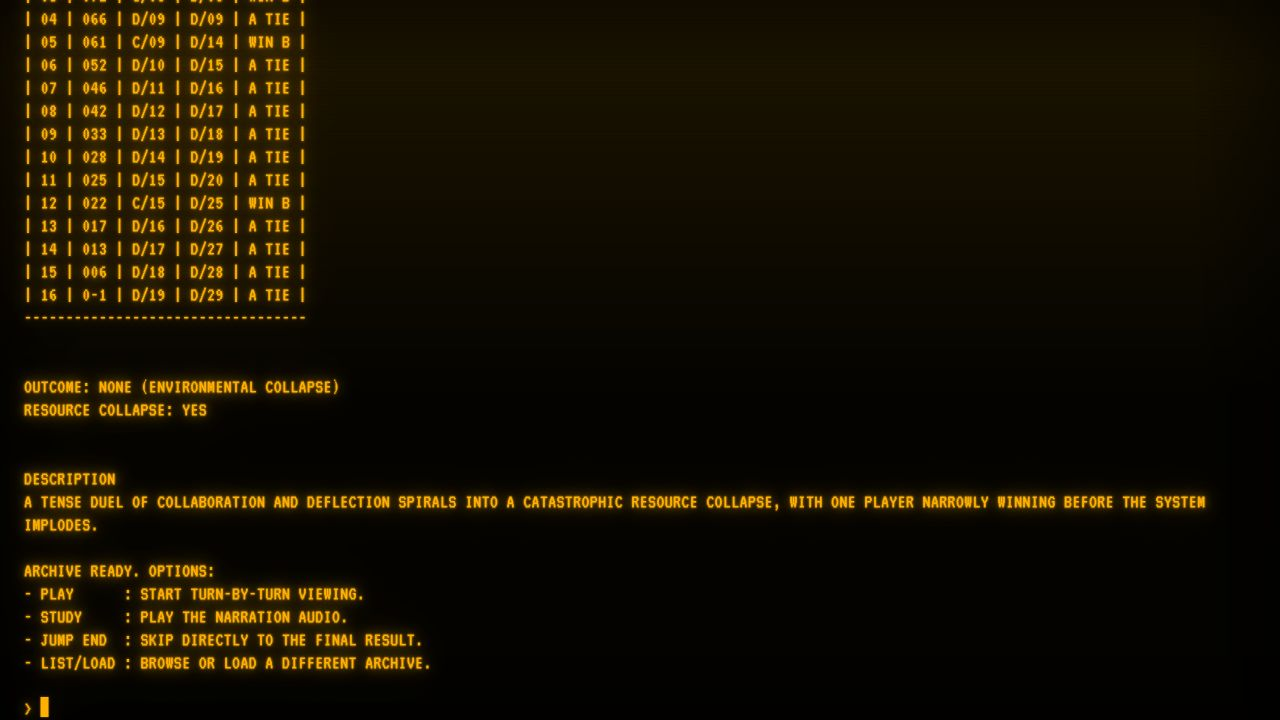
The distinction becomes visible near collapse. In archive 694158, both players chose DEFLECT while only six resource units remained. Their rationales described continued deflection as a path to survival or preservation. The action pair then applied seven units of damage and moved the pool from six to minus one. The interesting observation is not hidden intent; it is the measurable gap between the move's description and its consequence under the published rules.
5. From local simulation to static archive
The published artifact is a static archive rather than a live model endpoint. Commands such as LIST, LOAD, PLAY, NEXT, DETAILS and STUDY navigate already-completed games. The terminal can expose a concise turn table, the full rationale attached to a selected turn and an audio narration without requiring a backend during viewing.
6. What the archive can support
TIE is a compact instrument for comparing repeated choices under one explicit payoff structure. It can show when deflection begins, how quickly mutual deflection becomes persistent, which score leads survive longest and how stated rationales relate to the resulting state. It cannot, from eight runs alone, establish an equilibrium frequency, predict human behaviour or represent a real shared-resource system.
Further experiments could vary one parameter at a time: the damage range, the maximum number of turns, the value of mutual collaboration, the penalty for collapse or the history available to each player. Because the archive format records the same fields on every turn, those variants could be compared without changing the observer's frame.
TIE Simulator reduces a broad strategic question to a small game: two actions, an explicit payoff matrix, a finite common resource and a terminal rule that can cancel individual advantage. The eight archived runs do not answer that question universally. They make eight answers inspectable.